Monday, August 30, 2010

Para-dig-em

Devious idea of the day (brought to you in part by my friend Saideep):

Go to my Science, Technology and Society class tomorrow -- in which we will be discussing Thomas Kuhn's "Structure of Scientific Revolutions" -- and speak extensively about paradigms. Only I won't say "para-dime," I'll say "para-dig-em."

Would someone eventually (or right away) correct me? Or would they sit there squirming? Or would they not even notice?

If my life were a movie, I would try it. But alas, it's not. Para-dime it is.

Monday, August 23, 2010

"I wish I could say I gulp pure courage as I run, like those brave little girls you read about in stories, the ones who partner up with detective cats."

-- Karen Russel, from "Ava Wrestles the Alligator" in St. Lucy's Home for Girls Raised by Wolves

Sunday, August 22, 2010

Nostalgia Blows

Today I started reading through my old blog posts (the latest in a series of horrible ideas I've been having lately...) and it was like spying on someone else's life. I re-remembered all these oddball things that have completely vanished from my memory. At first I thought, Oh, cool, I am glad I did stuff like draw phallic-looking space shuttles on my first day as a teacher and run up Mt. Wachussett by myself.

Then I started to panic.

Oh bananas, I have to write down everything that happens to me -- good, bad, humiliating, surreal, and most important, hilarious -- because otherwise it will go on a walkabout and never come back. Of course that's an impossible task, but I can definitely do better than I'm doing now.

So yeah, sorry sorry, self-nullifying blog posts are worse than finding a worm in your apple (it FINALLY happened to me, after not believing that it really ever would -- see, this is the kind of stuff I need to remember!), but I just thought I'd let you guys know... And tell you that I'm going to make an effort to bounce back to my previous level of semi-awesomeness.

Tuesday, August 17, 2010

Why I love to bake


Some of you may have noticed that I have been twittering a lot about my baking aspirations (and, less frequently, achievements). You may have rolled your eyes. You may have thought, “We get it, Jordan, you bake stuff.” Well, there is more to it than that.

There are many reasons baking floats my boat (I have an obsession with sweet things; I like playing with technology; I lack the ability to cook actual meals), but there is one reason to rule them all...

When I am feeling poor and irresponsible and like I will never be a real grown-up, baking makes me feel like I am battling an evil army of orcs and I am WINNING.

It starts like this: I am procrastinating some very important task, like choosing a master’s project topic or paying bills or responding to important e-mails or applying for a job. Then an idea pops into my brain:

Scones!
Cupcakes!
Cobbler!
Chocolate-covered cherries!
Frosting!

Once said combination of sugar, butter and delicious gets into my head, it runs around wreaking havoc on my productivity. At this point, there is only one way to gain control of the confection-poltergeist that has taken up residence in my brain. I must bake it and defeat it. (Oh and eat it.) Then, and only then, will I be able to do the grown-up things I need to do.

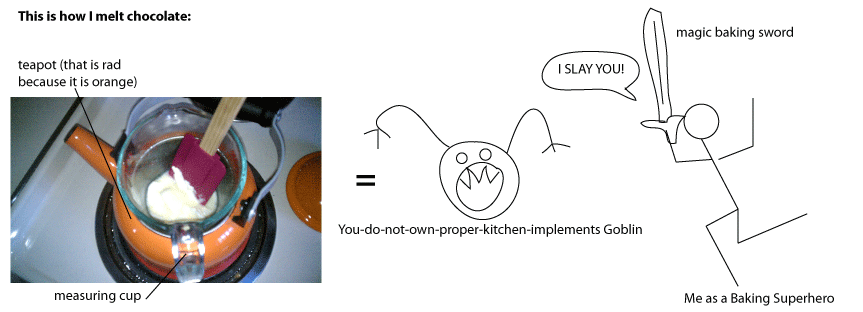
When I bake, I feel like I am a superhero with powers to defeat foes like the Baking-at-altitude-is-hard Troll! The Cakes-always-turn-out-ugly Monster! The You-do-not-own-proper-kitchen-implements Goblin!

These are challenges I can tackle. But then I rip off their masks and uncover their real identities and -- no way! -- underneath the Baking-at-altitude-is-hard Troll is the underlying problem that I live in Boulder and thus will never get a real grown-up job. (Cakes-always-turn-out-ugly Monster doesn’t have an alter-ago. He is just mean.) And the You-do-not-own-proper-kitchen-implements Goblin has a hideous real face of financial debt and a career choice that guarantees I will be poor forever.

But that’s ok, because as long as my real-life problems have their baking villain masks on I can slay them like a pro. And whereas before I started to bake, I felt like my only talents were getting drunk and embarrassing myself, and watching too many Degrassi episodes, and reading comics, now I feel like I can conquer some of my grown-up person responsibilities (even if really all I have done is bake something that will only make people fat and happy).

Here is an illustration of the process:


Monday, May 24, 2010

Beer Review: Green Dragon/OBC Bière de Garde, KING GHIDORAH


When I took my first sip of Green Dragon's King Ghidorah, on Saturday at Rogue's Brewer's Memorial Ale Fest, I had no idea its namesake was a three-headed flying beast who is Godzilla's bitterest enemy. I'm not sure who Green Dragon's version of the monster - a Bière de Garde, or French/Belgian style of beer similar to a Saison farmhouse ale - was intended to attack, because my nose, tongue, and belly loved it. Maybe this means I belong on the side of evil, and if that's the price of enjoying King Ghidorah, I'm totally fine with it. This beer was so good, if King Ghidorah is one of the bad guys, screw the good guys. This beer was tangy, fruity, fragrant, intense, complex, quizzical, and old-timey yet futuristic. I wanted to drink it while reading handwritten letters scanned into an iPad sitting on a vaguely mildewed bale of hay surrounded LEDs, candlelight, and the sounds of Titus Andronicus.

Unfortunately, King Ghidorah is destined to fade into a dreamy memory like the mythical creature it's named after. I will probably never drink this beer again, unless I track it down next time I'm in Portland. But all is not lost! I looked up Green Dragon - some Portland peeps had heard of this pub-turned-brewery - and though they don't yet have a real website*, they do have an elusive facebook page. There, I found information from the King Ghidorah release party (which already happened, dang), which included these tidbits:
"We formulated and brewed this with Brad Winter of the Oregon Brew Crew; it is quite unique and we took the unknown path. The majority was fermented and aged in a used Rogue Dead Guy whiskey barrel then blended with a portion fermented in stainless to smooth the whiskey and oak contribution - 87% barrel and 13% stainless. Within find hints of oak, vanilla, apricots, clove, cinnamon and whiskey with firm mouthfeel and subtle lingering flavors.

King Ghidorah
Bière de Garde
OG 20P ABV ~9.2% IBU 25 Color ~10 SRM
PCTBB Yeast / Wyeast 3726 Farmhouse Ale"

So the breadcrumbs have been dispersed. Maybe one day, once I've cut my homebrew chops, I'll be able to recreate it (or some equally progressive and otherworldly** Bière de Garde).

*Green Dragon folks, if all the beers you make are as good as King Ghidorah, I will so build a rad website for you - the only compensation I would require is enough beer to get me through the build process.

**The real (and by real I mean fictional) King Ghidorah is actually a dragon-like alien. Awesome!

P.S. Unfortunately, I didn't get any pictures of it -- they wouldn't have turned out very well anyway because the Brewer's Memorial cups were plastic and opaque. Anyway, it was a slightly cloudy orangish/amberish color with a good head.

Image is from Flickr user bweisner shared with a Creative Commons Attribution-NonCommercial-NoDerivs 2.0 Generic license

Monday, May 10, 2010

Early European Exploration of the Lower Colorado River

This semester, I honed by map-making, graphics, and web design skills (err, hone may not be the exact right word...) by building a website from scratch:

Early European Exploration of the Lower Colorado River

Here's a glimpse:


Now go explore the rest!

(And then report back with all your criticism -- which should be extensive.)

Friskies won't get out of my brain, and I like it!

I have a new obsession:


You think I'm crazy? Well, I do too. The first time I saw this commercial, I had a thoroughly "WTF?!" reaction. "This crap is ridiculous!" I told myself. But then I realized this is exactly what is going on in my cat's mind every time I open a can of food* for him. (*The fact that he is a Fancy Feast snob who wouldn't touch Friskies is irrelevant.)

Yes, cartoon turkeys, cows and flying fish dance, frolick and glide through his brain. (At least, he sure acts like it.)

I can't get the song out of my head. And you know what, I really don't care because I love it so much! Friskies, what have you done to me?

Here is the transcript (confession - I am transcribing it because it gives me an excuse to watch the commercial one more time):

What if one little pop could open a world of wonder?
So sensory. So satisfying.
The discover never seems to stop.
A journey to delicious and beyond.
Exciting your cat day and night with endless enchantment.
It's the magic Friskies makes happen every day, in so many ways.
Friskies: Feed the senses.


Update: Seth Stevenson at Slate covered this commercial in "Advertising Deconstructed":

I asked Friskies marketing director Susan Schlueter to explain. What followed was a fascinating glimpse into the world of feline feeding rituals. (Perhaps you knew this stuff already. As I lack a cat, or any experience tending cats, it was new to me.) Apparently, dry food is left out all day for cats to nosh on. Kitty will take a few desultory nibbles, but then go back to chasing dust motes or clawing at upholstery—leaving the remainder of the desiccated food in the bowl for later. By contrast, wet food is a once- or maybe twice-a-day treat. When that can of wet food peels open, kitty hops up onto the countertop and eagerly slurps until she reaches the final drop of yummy slop.

"Feeding wet," as Schlueter calls it, can for some owners be a highly ritualized and intimate pet interaction. The pop of the can primes kitty for excitement. The scents that escape set feline nostrils aflutter. This is a time for cats and owners to bond over a heap of moist, processed meat. And, according to Schlueter, many owners like to imagine what their cats are feeling and thinking during these moments of culinary ecstasy. This trippy ad, which is for wet food, is meant to capture the altered consciousness of the cat—the sensually heightened bliss it derives from chewing on a pile of damp Friskies.


So so true. The marketing team at Friskies knows me and my cat so well.

Monday, April 12, 2010

Accepting Rejection: My On-Again-Off-Again Relationship with Science and Journalism (Part 1)


"Write a blog post that took weeks of reflection before you heard the inner voice that needed to come out." -- Jaron Lanier, You are Not a Gadget*

Last Tuesday, at 1:27 pm, I got rejected from a summer science communication internship. Three hours and 12 minutes later I got rejected from another. (The first was in the Eastern time zone, the second Pacific, so really they were within 12 minutes.) Both were from federal agencies, and both gave ostensibly the same reason: they decided to go with someone who had more of a science background in each respective field (ecology, atmospheric chemistry).

Granted I was tired, and getting rejected serves to sour an already foul mood, but this had more of a puckering effect than usual. Let’s assume that each job was truthful in their reasons for rejection (and this wasn’t the workplace version of “I think we'd be better off as friends” or "Well, he/she has a great personality..."). It raises a critical question for my career aspirations: does someone need to be an expert in a field to write about it?

I just read an excerpt from John McPhee's profile of Bill Bradley. It was amazing. Instead of describing its amazingness (I'm no John McPhee...yet), here's one of my favorite passages:

Last summer, the floor of the Princeton gym was being resurfaced, so Bradley had to put in several practice sessions at the Lawrenceville School. His first afternoon at Lawrenceville, he began by shooting fourteen-foot jump shots from the right side. He got off to a bad start, and he kept missing them. Six in a row hit the back rim of the basket and bounced out. He stopped, looked discomfited, and seemed to be making an adjustment in his mind. Then he went up for another jump shot from the same spot and hit it cleanly. Four more shots went in without a miss, and then he paused and said, "You want to know something? That basket is about an inch and a half low." Some weeks later I went back to Lawrenceville with a steel tape, borrowed a stepladder, and measured the height of the basket. It was nine feet ten and seven-eights inches above the floor, or one and one-eight inches too low. [From The John McPhee Reader, page 7]

What I love about this passage is that you don't have to know much about basketball to know what McPhee is trying to tell you about how Bradley approaches the game. You don't have to know anything, actually. But if you do know a lot about basketball, it is still fascinating.

Would you rather have had McPhee write it – someone who is knowledgeable about the sport, but hasn’t devoted his entire life and career to it – or say, a basketball coach, who may have more expertise in the game but isn’t as great a writer or journalist? I think it’s obvious what my answer would be. What do you think?

And why, exactly, is McPhee the right choice?

McPhee can always go ask the top basketball coaches what they think of Bradley’s style of play, his understanding of the sport, his contributions to the game (which he did). But could a basketball expert ask someone to help him write? Going past that, McPhee's art doesn't just come from his skills as a writer: It comes from his skills as an observer and a thinker.

My whole life I’ve felt I’m too much of a scientist to be a writer or too much of a writer to be a scientist. So what does a misfit like me do? Outwardly, I came back to school to write about science and the environment. But I really came to construct thoughtful narratives with beautiful storytelling. I came because of writer-thinker-observers like John McPhee, Elizabeth Kolbert, Robert Sullivan and Jonah Lehrer. I came because I believe that storytellers – journalists, writers, reporters, whatever you want to call them – do an invaluable service for the world. They listen to noise, sift through the cacophony, and pump out coherence. They take in chaos and turn out meaning. By doing that they aren't just translating facts from one medium to another: They are creating something new.

You could argue that scientists do the same thing: The chaos is the universe at large, the meaning is our (empirically proven) body of knowledge. But they go about it very differently. Scientists design a question, a hypothesis and, often, a manufactured test to cull meaning from chaos. Journalists aren't taught a rigid methodology. They set out a wide net, collecting everything they can, and then organically (holistically?) – often without a conscious process – turn that information into a story. They add some sort of hierarchy to the information, assign it value and meaning and context. The process is not as proscribed, but also it is not as narrow. I’m not going to say one is better than the other, but these different approaches yield different results. And the world needs both of them.

Federal agencies that rhyme with eepeeyay and enpeeyes only need the former, apparently. :) Just joshing! I still have a whole lotta love, despite my dark and dirty moments of rejection.

*27 pages into Jaron Lanier's book, I have to confess that I don't know what he's talking about half the time, but I do know that I like it. This is part one in a series I've been working on in my brain and in my scribbles and in my ENVS5100 weekly one-pagers about science and culture and other woo-woo-goodness. At first I felt bad about taking too much time to mull over all these thoughts jousting in my head, but Lanier has given me an excuse to keep mulling for a while, in the name of a rebellion against the prevailing internet singularity (or something).

This post brought to you by: Ska Brewing Co.'s masterpiece, Modus Hoperandi; the Conference on World Affairs; John McPhee and Bill Bradley; my science and technology policy class, ENVS5100.

Tuesday, March 30, 2010

Geoengineering madness! (And I do mean madness...)


Geoengineering makes me think of two scenarios: arch-villain plots (now I will block out the sun...muwhahaha!!) and well-meaning scientists too focused on finding a solution to the world's problems to recognize their own hubris.

Well, yesterday's panel on geoengineering -- sponsored by the University of Colorado's Cooperative Institute for Research in Environmental Sciences and populated with local rockstars Bill Travis, Lisa Dilling, Max Boykoff, Rachel Hauser, Ben Hale, and Roger Pielke, Jr. -- gave me a new image: academics grappling with the sticky issue of semantics as a proxy for grappling with the even stickier issue of geoengineering itself.

The technology for geoengineering -- or the less scary earth systems engineering or climate intervention -- is still in its infancy. And, as you'd expect, the policy approaches to how we might deal with it are even less developed.That made for a really great panel, as the audience got to see the panelists views shape and evolve as they responded to questions. I'll give a quick and dirty rundown of the panelists' main points (later!), but first...

Observing this event made me think about all the ways I could possibly write about this. And that in turn led me on a a trip through my educational history (seriously, you can jump to the end for the bullet points if you want).

In my OES days of excessive liberal arts thinking...
Hmm, but what are the main assumptions the panelists are making here?
  1. Global warming is actually occurring
  2. Science and technology and empiricism are sound methods for uncovering knowledge
  3. We are all sitting in this room at this moment, listening to this talk
What happens if I undermine those assumptions? Why are we even talking about geoengineering when we have no proof that anything exists outside of our own minds? Ahhhhhhhhhhh! I'm going to the desert to have a spiritual journey.

In my MIT days of engineering overload...
How can we accurately characterize the views of the panelists to the nearest order of magnitude? I think four out of the six panelists are against global warming, so that's basically the same as saying that they all agree geoengineering is a bad idea. If that's the case, why are they still talking?

In my senior year of college, when I was taking my nature writing class really seriously...
But what does the discourse on geoengineering tell us about the human condition? Maybe I'll go find a stream, build a tiny dam, observe what happens, then come back and stare at a blank wall and write about it.

In my days as a high school teacher...There has to be a teaching moment in here...but what is it? I know! I could use geoengineering to teach my seniors about the laws of thermodynamics. And then we could watch a movie. Maybe The Core.

In my first year as a journalism student...
But what's the most important nugget of information? Before technologists and policy experts can tackle geoengineering, they first have to decide what it is. No, too boring. CU policy experts pan geoengineering? No, too simplified. Lisa Dilling had a good quote about a volcano that I can probably use...

In my second year as a journalism student, riddled with disillusionment, looking to comics for storytelling inspiration (I've been reading a lot of Scott McCloud and Will Eisner lately, which has been enlightening, but hasn't improved my skills at cartooning or humor)...


But none of those is quite right. Instead, I'll just barf some of my notes onto you. Enjoy!

Lisa Dilling:

  • She attended last week's Asilomar Conference on geoengineering, where the conference organizers kept trying to draw parallels between geoengineering today and recombinant DNA technology in the 1970s. Dilling wasn't buying the comparison.
  • At the conference, she listened to lost of debates that distinguished geoengineering research from geoengineering deployment. Dilling wasn't buying that either: you can't have research without discussing its applications.
  • No one knows what to call geoengineering, and what to include under its umbrella. Does planting trees count?
Max Boykoff:
  • He also attended the Asilomar Conference, and was also bothered by the historical comparisons with recombinant DNA.
  • Boykoff was concerned about the representation at the conference -- it was conspicuously lacking members of the "global south."
  • He felt, "at times we were bordering on some delusions of grandeur about what can be done."
  • He gave a panel on media representations of geoengineering: basically, there aren't any yet because it's completely missing from public consciousness.
Rachel Hauser:
  • She attended Asilomar, and stayed for a special session on cloud whitening. It sounds so friendly, doesn't it?
  • She observed that engineers and climate scientists have trouble communicating with each other.
  • The "quick" time scales that geoengineering proponents love to flaunt are really on the order of decades.
  • There are no really gung-ho geoengineers out there -- even those with vested interests are wary of the moral and technical issues involved.
Ben Hale (indie environmental philosopher!):
  • He tackled the ethics of remediation, which is in effect turning back the clock on the environmental wrongdoings we've already done.
  • He outlined four criteria for a successful geoengineering project, based on the work of Dale Jamieson of NYU:
    • It has to be technically feasible
    • The consequences must be predictable
    • The outcomes must produce desirable (i.e., better than present) social and economic states
    • It must not seriously violate any ethical standards
  • Well, to date at least, no geoengineering solutions meet all four...
Roger Pielke, Jr.:
  • He starts to feel uneasy whenever a community -- like geoengineers -- start to self-regulat and self-govern. For example, the conference was sponsored by a group who has a stake in a geoengineering start-up. That's a big red flag.
  • He thinks geoengineering is a "slippery term" -- it should include things like solar radiation moderation (i.e., artificially creating the effects of a volcano with particles), but not carbon dioxide removal.
  • He also thinks, "geoengineering is a horribly bad idea." We just aren't good at undertaking large scale experiments on ecosystems. Behold: Australia's introduction of the cane toad.
  • Pielke cited three criteria for when technological fixes (i.e., vaccines, glasses) work, based on work by Daniel Sarewitz:
    • There must be a clear cause and effect relationship between the technological intervention and the desired outcome
    • The consequences must be able to be unambiguously assessed
    • The technological solution must build on a pre-existing technological core
  • Geoegineering fails all three...bing bang boom!
Bill Travis:
  • He wonders why are are framing geoengineering as a purely emergency measure. Maybe it's not?
  • He's also interested in whether the possibility of geoengineering might distract people from other solutions (mitigation, adaptation, social behavior modification, etc.).
  • How do we know what an emergency looks like? Can we see it coming, or only tell once it's here?

For further reading, check out:


[Image from Flickr user flydime shared with a Creative Commons Attribution License]

Monday, November 02, 2009

A cat, a tooth, a dream...anxiety!

This morning I had a nightmare. My cat Murphy had crawls into my bag (obviously, because he stows away and comes with me undetected all the time...duh). So there we both are, in a coffee shop. Nothing weird about that, right?

The coffee shop patrons start cooing over Murphy -- who wouldn't? One of them notices something is not right: Murphy's bottom front tooth (do cats even have a tooth there?) is about to fall out. And it is green and slimy and rotting and putrid.

[Backstory: This totally preventable catastrophe is my fault. When I took Murphy to the vet six weeks ago I found out that he needs $400 worth of dental work. Right, I don't have that kind of money. So I did what I do best: I put if off.]

Ok, returning to the dream... A frantic search for the vet's phone number ensues. I can't find it. When I do find it, they don't answer. Time is ticking. All of a sudden it is 10 a.m. (or is it 11 a.m.? In my dream I forgot daylight savings...just like in real life) and I am late for class. And Murphy is trying to escape. And his TEETH ARE FALLING OUT!

...and I wake up.

Phew. So normally analyzing dreams is a futile yet totally unavoidable process. It's the grand goal of us instinctively pattern-seeking humans -- tease some sense out of a mess of images.Valiant efforts have been made (Freud, Jung, and, as Wikipedia tells me, a slew of neurologists) to explain dreams but, like trying to train a chicken, it's mostly futile.

Until, of course, Jordan Wirfs-Brock hits the scene. Ok, not quite. My dream made me realize something, but that something wasn't about the nature of dreams. It was about the nature of pets. Pets and people. People and pets.

Anxiety dreams are crazy common, and teeth falling out is a frequent target. I've had that dream countless times (and damn, it's frightening), but this is the first time I projected that anxiety on an external actor: my cat.

In my dream, along with the teeth falling out thing, I was nervous about:
  • making it to class on time

  • money

  • fitting everything in to my schedule

  • the BURDEN of carrying things around with me

Hmmm, funny, these are all things that were tugging at the corners of intricately woven quilt of worries this morning. I had set my alarm early to go and search for my lost USB data drive which held, yes, "important assignments". Gah.

So here's the revelation. Maybe one of the reasons we have pets (besides the companionship and the fuzziness and the adorableness) is so we can push the anxiety of our people problems on to our pets.

There is generally little emotional wiggle-waggling involved in this process. Does Fido or Mittens need something? OK, it's done...no need to worry about whether your dog emotionally and intellectually fulfills you, or whether you are living up to your full potential when you are helping your cat. It's a different, more manageable, less ambiguous kind of anxiety. This is, I maintain, distinct from another reason we have pets: the desire for unconditional acceptance.

If you, like me, most likely were a Baby 19 and have a form of anxiety disorder somewhere between mild and severe, having a pet lets you channel that anxiety in a way that at least feels productive. Is it exploitation of the animal kingdom? Probably. Is it merely a distraction from dealing with those real people problems I mentioned? Maybe. Am I ever going to stop having anxiety dreams about Murphy that are really about me? Definitely not!

P.S. Also, I just really love typing the word "anxiety." It is so strange.